Everyone talks about ATS compatibility.We measure it on German ATS.
You apply through German employer portals whose insides you never get to
see. We send our CV templates through three commercial parsing engines —
the same technology that sits inside the applicant tracking systems German
employers run. We check ATS compatibility continuously and adjust the
templates as soon as a measurement finds something. This page carries both
halves: what we can prove, and what we cannot.
Exhibit 01no commentary
One email address in a narrow sidebar column, three commercial engines.
This is how it arrived in each data set:
1 %of companies let AI pre-sort applications for themBitkom
The real risk is quieter: your data arrives damaged, and nobody notices.
No system throws you out for using two columns. But if your email address lands
incomplete in the data set, nobody can reply to you — and the recruiter does not
see a defect, only an applicant who never got back to them. That is the class of
damage we measure.
03
What actually reads you
Most applicant tracking systems don’t build their own parser
They buy it in — and largely from the same supplier. In the German-speaking core
market, six of the nine systems we checked work with Textkernel; the
international suites you will also meet here run partly on other engines, partly
on their own build. You upload into these portals without ever seeing what
happens next. This is the part you can see: every row carries its public source,
and you won't find this list in any comparison article.
The built-in engine is not necessarily the only one
SuccessFactors reads with Textkernel by default —
RChilli is installable as an add-on module.
With Oracle it is exactly the other way round. So two companies on the same HR
system can read your CV with different technology.
For you that has one practical consequence and one reassuring one. The
practical one: “optimise separately for each system” does not work, because you
don’t reliably know the system. The reassuring one: if you apply to ten
companies, you’ll statistically land on the same software more than once — so
one cleanly built document works more than once.
The errors arise in the document, not in the systems of these vendors. We are
not grading any of them here.
04
One email, three engines, three errors
What you see is not what arrives
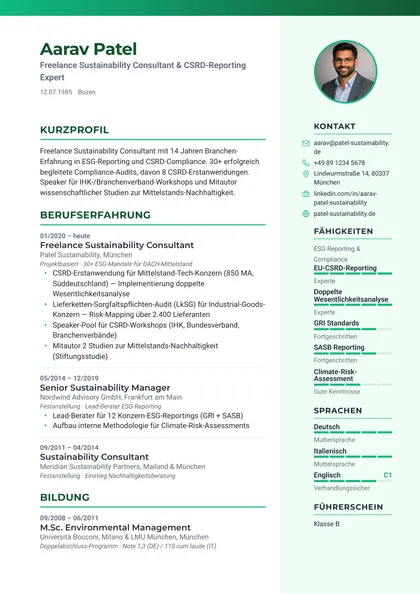
A narrow sidebar column forces long values onto two lines. For you it’s
invisible — in the PDF everything is right there in full. For a parser it is the
most expensive line break in the whole document. That is what we provoke and
measure. The table shows the hardest case we measured: one and the same address,
broken at the hyphen, read by three engines. The sheet beside it shows, on one of
our templates, what such a break point looks like. How we keep it out in daily
operation is in section 05 — and where a break is allowed to stay, in section 07.
One of our templates · page 1, original
01
02
01Email address — breaks after the dot, the “de” sits alone on the second line
02Profile URL — same pattern, second field of the same sidebar
Unaltered render from the product pipeline · German-language template with a narrow sidebar · nothing staged
The break point · detail from 01
Break
The same render, only enlarged · to you the address looks complete and legible
The data set · email field3 engines · default configuration · our own measurement
Engine A, B and C are three commercial parsers from exactly this market.
Which engine sits inside which applicant tracking system is in the map
above — and we deliberately attach no names to the measured values here.
The first case is the most expensive one. The address is syntactically valid
and factually undeliverable: the recruiter cannot reply to you, and nobody
finds out why. Phone numbers, by the way, arrived correctly everywhere — it
hits the longest field in the narrowest container.
And before anyone reads this as a vendor comparison: none of the three comes
off well here, and none of them is to blame either. The break sits in the
document, the engines merely deal with it differently. One configuration and
one snapshot are far too thin to grade a vendor.
The knock-on damage nobody expects
A torn profile URL does not only cost its own field. It contaminates name
detection: one engine read the first name out of a fragment of the LinkedIn URL
instead of out of the document header.
With a torn URL · name fieldLin Schneider-Weber
→
With an intact URL · name fieldThomas Schneider-Weber
The “Lin” comes from linkedin.com/in/… — the document
was visually correct and unchanged. So a single break in the wrong place can
spoil several fields at once.
05
Continuous checks, not a badge
How we keep this true — on every change
The measurement isn’t designed as marketing but as a check on our own templates,
and it runs continuously: the classes of error it makes visible run as blocking
tests on every change. Here is what that looks like in practice.
Renderer
The text stream follows reading order
A PDF stores text in the order it is drawn, not in the order you read it. With two columns, the two interleave. Our templates write the text stream in reading order: between the start of the document and the detected name there are 9 positions, not the 516 you get from naive drawing order
9 instead of 516
Templates
Contact values stay on one line
Email address and profile URL are set so that they do not wrap — with two documented exceptions, which are in section 07
Layout rule
Test run
A line break never slips through unnoticed
The wrap check runs as a blocking test on every change and fires in both directions: on a new break just as much as on an expected one that suddenly disappears
build-blocking
Studio
The warning comes before the choice, not after
If your addresses are too long for a narrow sidebar, the studio tells you while you are designing — and offers the single-column layout instead
in the product
That’s why we trust no badge — we see for ourselves what a measurement turns up.
Anyone who has never put their templates in front of real engines has never had the
chance to find their own errors either. A seal without a published method says
nothing about whether anyone ever looked.
06
Two assumptions, lost to measurement
One engine proves nothing at all
The most credible part of a measurement is the part where you turn out to be
wrong. Two of our own assumptions did not survive it — and with only one engine,
neither would ever have shown up.
discardedAssumption 01
“A break only hurts at the hyphen and at the dot, not at the @ sign”
Measurement
We built a variant that breaks exactly there — and it got worse. One engine
then returned no email field at all and additionally invented a website
address out of the severed remainder.
Consequence
Contact values must not break at all, no matter where.
discardedAssumption 02
“We have found two more defects in our templates”
Measurement
A misread first name and torn job titles occurred with one engine only. The
counter-check with the second read both correctly — they were quirks of that
one engine, not document errors. The third then brought one of the two
effects back after all.
Consequence
A finding from a single engine is not a result, it is a hunch.
An “ATS-checked” badge based on a single tool says as much as a spelling test in a single language.
How the market evidences “ATS-checked”
We've looked at what the common compatibility promises actually rest on. They fall
into three patterns — and none of them contains measurement data.
Pattern 01
The bare claim
“ATS-optimised templates”, “easier for an ATS to read” — no method, no data, no check anyone could follow
Pattern 02
The simulation as a stand-in for proof
An in-house checker with “30 checks” that “reads like an ATS” — measured against an imitation, not against a real engine
Pattern 03
“We test internally”
Tested against unnamed parsers, without names, without method, without numbers — and partly disproven by third parties already
“When you submit your CV for a job, the ATS does not score it. The match rate in
our own scanner is a visualisation tool.”
From the disclaimer of one of the largest score providers · paraphrased
That’s remarkably candid — and it devalues the entire score category. There is no
points total your CV achieves at the employer. There are only fields that arrive
and fields that do not.
07
The limits of this measurement
What we don’t know — and tell you anyway
Without this section, this page would itself be just a claim. Three things we
cannot evidence, and one loose end stays open in our own product.
On German section headings we can say nothing
The most popular question is: “does the system recognise my heading as work
experience?” None of the three engines returns a section model for
German-language documents — those fields stayed empty across all twelve
German-language templates and were only populated for the English-language
ones. So for the German market we can’t answer the question, and we don’t
pretend to.
If you apply in English, that difference is real and in your favour: the same
engines do produce a section structure for English documents. What a company
then does with that structure is the next limit below — and it is not
something we measured.
We measure the parser, not the selection afterwards
What a company does with the extracted data — filter, sort, rank — is a
different layer and configured differently in every organisation. This
measurement says nothing about it.
Three engines, one setting, one point in time
Default configuration, one test persona per template. Vendors change their
models, and a different configuration can produce different results. Every
single run against the engines is therefore a snapshot — the measurement PDF
further down names the state it reflects.
Two of sixteen profiles keep the break — and we tell you beforehand
On the four templates with a narrow sidebar, very long addresses do not fit
on one line. In our test run that affects two of sixteen test profiles, each
with addresses of around 39 characters. We deliberately decide against
breaking the design for it: the look of those templates is the reason
somebody picks them.
Instead, the studio tells you while you are designing that your
address is too long for that sidebar — and offers you the single-column
layout. You make the call, not us, and you make it beforehand rather than
afterwards.
08
For your own document
Check it yourself — it takes two minutes
You need neither us nor a scoring tool for this, and no extra software either.
Seeing your CV the way a machine reads it takes three steps you already know.
01
Open your PDF
In whichever viewer you like — Preview, Acrobat or simply the browser
02
Select everything and copy it
Ctrl + A, then
Ctrl + C — on a Mac
Cmd instead of Ctrl
03
Paste it into a plain text editor
Notepad, TextEdit, an empty document — anything without layout. What appears
there is roughly what an applicant tracking system reads out of your file:
your text stream, without the design
Four questions for the result
Is your email address there in one piece, or split across two lines?
Is your profile URL complete, including its very last character?
Does the content come column by column, or does it jump between columns?
Is your name at the very top, or does a fragment from the sidebar appear before it?
To be honest about it: this only imitates the simplest class of parser.
Commercial engines additionally run a layout analysis and often assign columns
correctly — so your copy-paste result tends to look worse than what arrives with
them. But exactly the class of error this page is about — torn values in narrow
columns — becomes visible this way. If everything is there cleanly and in a
sensible order, you are on the safe side with the large majority of systems.
If you want to go deeper: the tool-based route — the same check on the command
line — is in the measurement PDF further down. And if you want the practical rules
for applying in Germany rather than the evidence behind them, they are in our
guide on ATS in Germany.
09
Frequently asked
Briefly answered
The questions that keep coming up around ATS and CV parsing — answered with what
we can evidence.
Can applicant tracking systems read two-column CVs?
As a rule, yes. The popular rule “single column or it will not be read” is not what our measurement found in that severity: the engines with layout analysis assign columns correctly. The real risk is not the columns, it is the line breaks inside them — a narrow sidebar forces long values such as your email address onto two lines, and that is exactly where the errors happen. If you want a two-column design, make sure contact details stay on one line or sit in the wide column. Short addresses are more robust, and write profile URLs without the “https://www.” prefix — that saves twelve characters nobody needs.
Going by everything that can actually be evidenced: almost never. Only around one per cent of companies in Germany let AI pre-sort applications. The much-quoted figure of 75 per cent of CVs being rejected goes back to a sales pitch from 2012, not to a study. The risk sits somewhere else: if your data arrives incomplete in the system, you will not be found in a search, or nobody can reach you. You are not filtered out, you are simply not findable.
PDF or Word — which one is read better?
Both work, as long as the text stays real text. A PDF saved as text is usually the safer choice because it protects your layout on the way. What matters is not the file format but what sits in the text stream — which is exactly what the self-check above shows you. The only genuine taboo is an image PDF or a scanned CV: there is no machine-readable text in those at all.
How do I know which system a company uses?
Mostly you don’t — and that matters less than it sounds. The domain of the application form often gives away the vendor, but the built-in engine is not necessarily the only one, and two companies on the same system can read with different technology. That’s why “optimise separately for each system” buys you little. What helps is a document whose values arrive complete in every engine.
What is an “ATS-checked” badge worth?
Exactly as much as the method behind it — and that is almost never stated. In our own measurement we found two apparent defects that turned out, on the counter-check, to be quirks of a single engine. A badge based on one tool would have reported both as real errors. So don’t ask whether something was checked, ask with what, against what, and with what result.
The measurement as a PDF
Method, findings and limits as one coherent document — to pass on to
colleagues, to use in career counselling, or to keep at hand when preparing
your own applications.
The same check this page documents runs on every change to our templates. You don’t
have to think about text streams and line breaks — you only see the result.
Free to start · no credit card · servers in the EU
Cookies & analytics
With your permission, we use analytics cookies to understand how the site is used — anonymously. Your data stays safe in the EU, and the core features work without cookies too. You’ll find the details in our privacy policy.